5 Common Conditions Spinal Decompression May Help
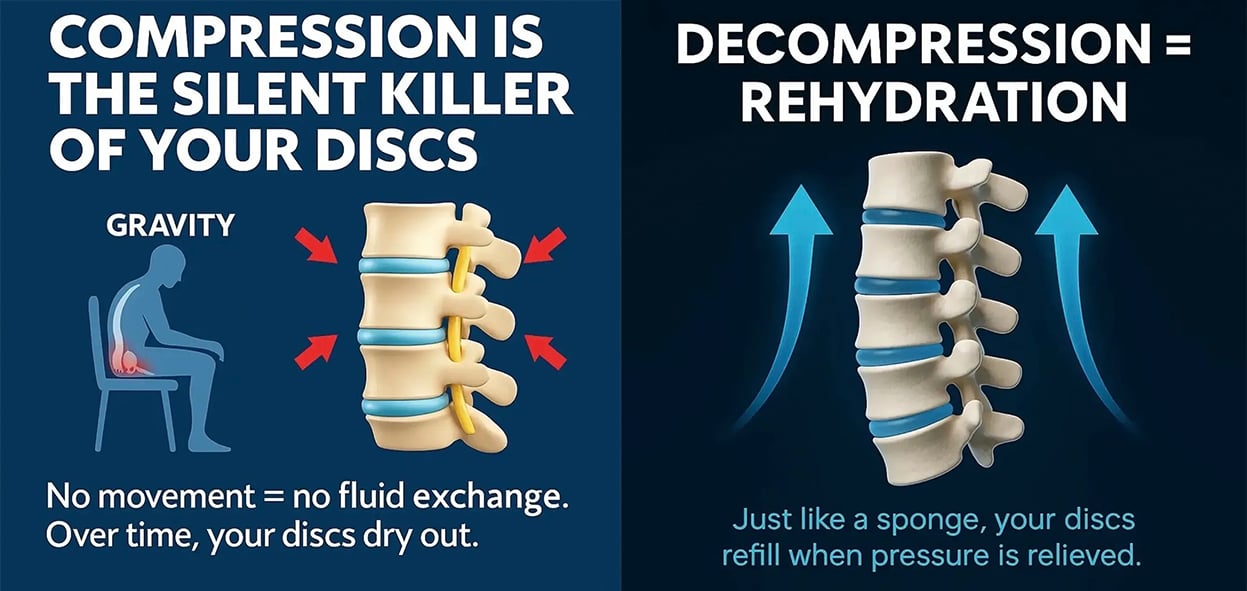
Spinal decompression is often thought of simply as a treatment for back pain.
But the real goal is broader than that.
Spinal decompression is designed to gently reduce mechanical pressure through the lower back and create a healthier environment for the discs, joints, and surrounding nerves.
At Spine Studio, we use the ErgoFlex Back on Trac system, which allows controlled lumbar distraction without the belts, harnesses, or upside-down positioning used with some other forms of traction.
Here are five common reasons someone may benefit from spinal decompression.
1. Chronic Low Back Pain
Long-standing lower back pain can be associated with many different structures, including the discs, joints, muscles, and surrounding tissues.
When excessive mechanical stress is part of the problem, spinal decompression may help reduce some of that pressure and allow the area to move more comfortably.
2. Bulging or Herniated Discs
A bulging or herniated disc can irritate nearby tissues and, in some cases, place pressure on a spinal nerve.
Decompression does not simply “push a disc back into place.”
Instead, the goal is to reduce mechanical loading around the affected segment and create a less stressful environment for the disc and surrounding structures trying to give the disc more space to sit and function more normally.
3. Sciatica or Radiating Leg Pain
Sciatica usually involves irritation of one of the nerves that travels from the lower back into the leg.
Symptoms may include pain, tingling, burning, or numbness.
When disc-related pressure or mechanical irritation is contributing to the problem, decompression may help reduce some of that stress around the involved nerve.
4. Degenerative Disc Changes
As spinal discs age, they may gradually lose hydration, height, and flexibility.
This is often referred to as degenerative disc disease, although many people have degenerative changes without significant symptoms.
Spinal decompression may help temporarily reduce loading through these areas while encouraging movement and fluid exchange within the disc.
5. General Back and Disc Health
This is one of the most overlooked uses of decompression.
Your spinal discs have very little direct blood supply.
Instead, they depend heavily on the movement of nutrients and fluids through the surrounding endplates.
Think of your disc like a sponge.
When it is compressed, fluid is pushed out. When pressure is reduced, fluid can move back in.
That natural cycle helps support the movement of substances such as water, oxygen, and glucose into the disc, while metabolic waste products move out.
Spinal decompression creates repeated periods of gentle loading and unloading, which may help support this natural exchange.
For some people, decompression may therefore be useful not only for current symptoms, but also as part of an overall strategy for maintaining better spinal mobility and disc health.
What Makes Back on Trac Different?
The ErgoFlex Back on Trac system begins with the patient in a comfortable seated position.
The chair gradually reclines while controlled distraction is applied through the lower back.
There are no restrictive torso harnesses, and you do not have to hang upside down.
For many people, this makes the treatment comfortable and easy to tolerate.
Spinal Decompression in North Fort Worth and Keller, TX
Spine Studio provides spinal decompression therapy for people living in North Fort Worth, Keller, and surrounding communities.